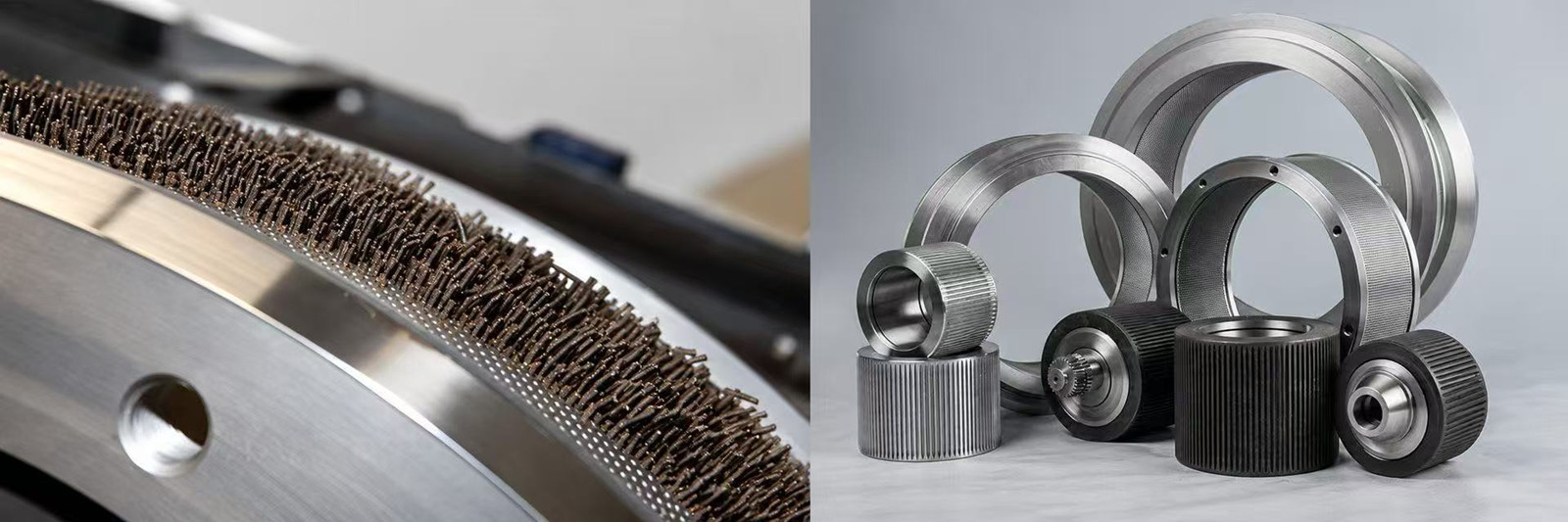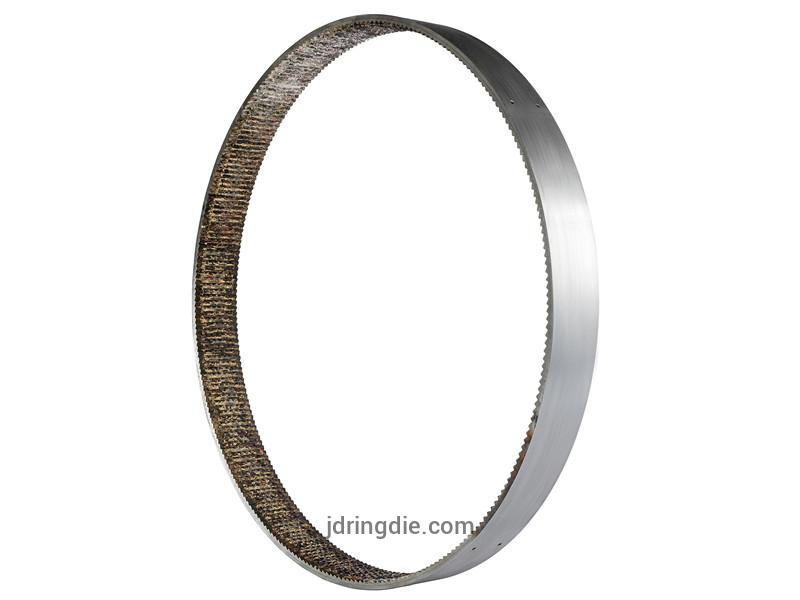


Inside an ultra-fine pulverizer the ring gear is the stationary toothed surface and the hammers are the moving ones. Coarse particles entering the chamber are caught between the two and broken down by impact, friction and shear until they reach the required fineness.
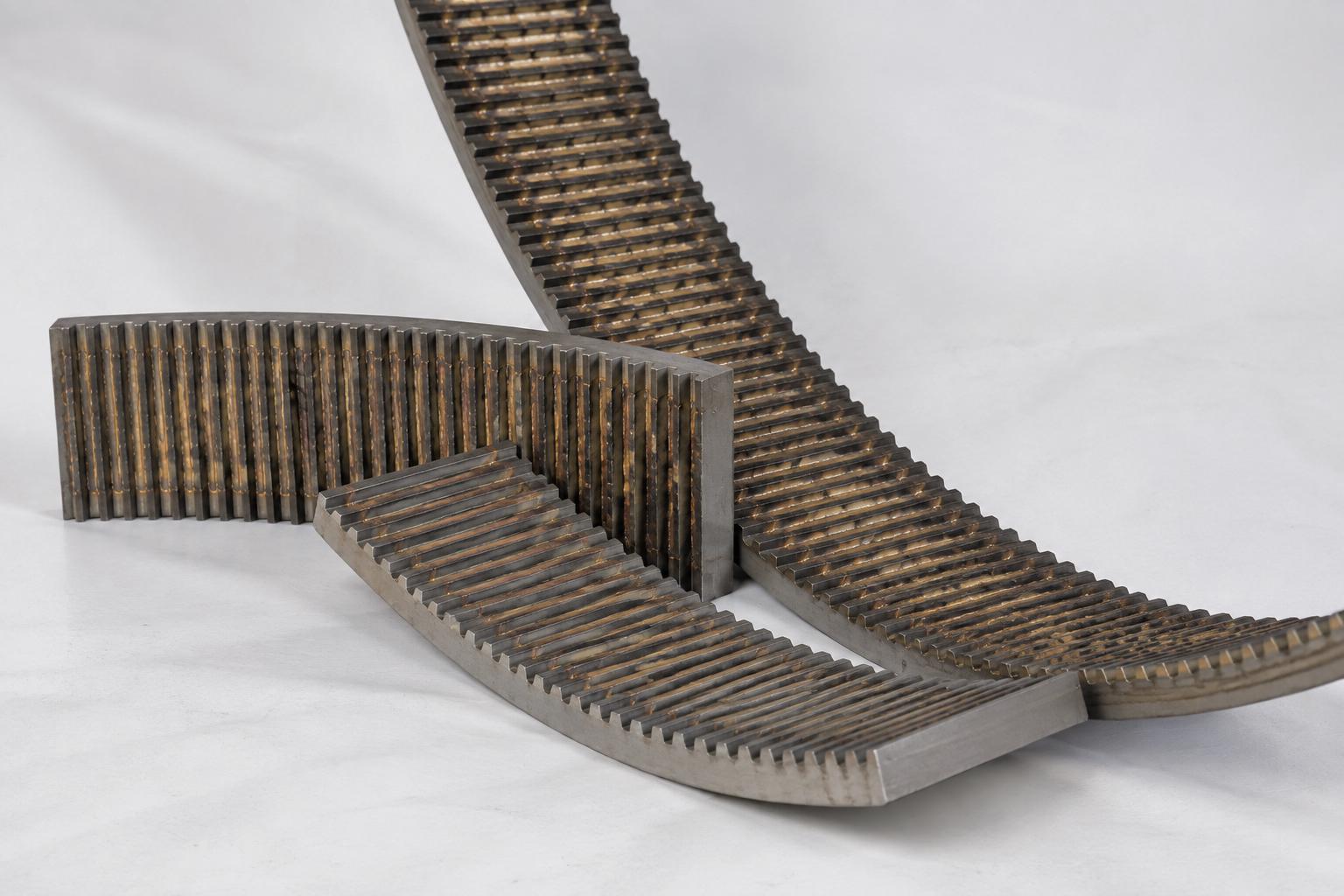
The tooth face is the anvil. How it is shaped decides how material is presented to the hammer, which is why tooth form belongs in the specification and not in the foundry detail.
◆ Present material to the hammers — the tooth face holds the particle long enough to be struck.
◆ Hold its shape — a tooth that rounds over stops presenting material squarely.
◆ Carry the wear — the alloy layer, not the ring body, absorbs most of the abrasion.
◆ Keep the flow path open — worn or built-up teeth change how material travels around the ring.
This is also why the angle at which alloy is laid on the tooth matters. A larger frontal face takes a more direct strike from the hammer; a smaller one lets material travel further before it is hit, which changes both fineness and output.

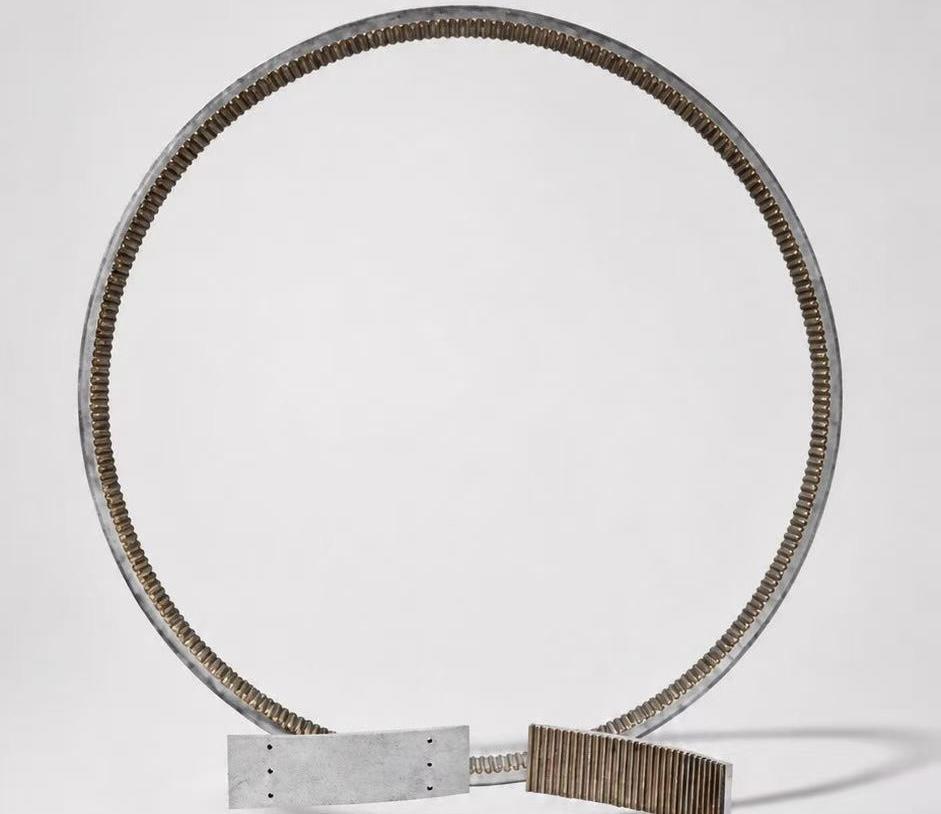
A ring gear can be made as one closed ring or as segments joined inside the machine. Both grind the same way; the choice usually follows how the mill is serviced rather than how it runs.
Split ring gears are easier to install and replace, which matters where the pulverizer is serviced in place. The trade-off is the joint: each joint has to locate cleanly and carry its share of the load, so the segments are matched to each other rather than made as loose interchangeable pieces.
Tell us which construction the machine uses today. Changing between the two is a machine question as much as a part question, and it is settled before the ring is made.


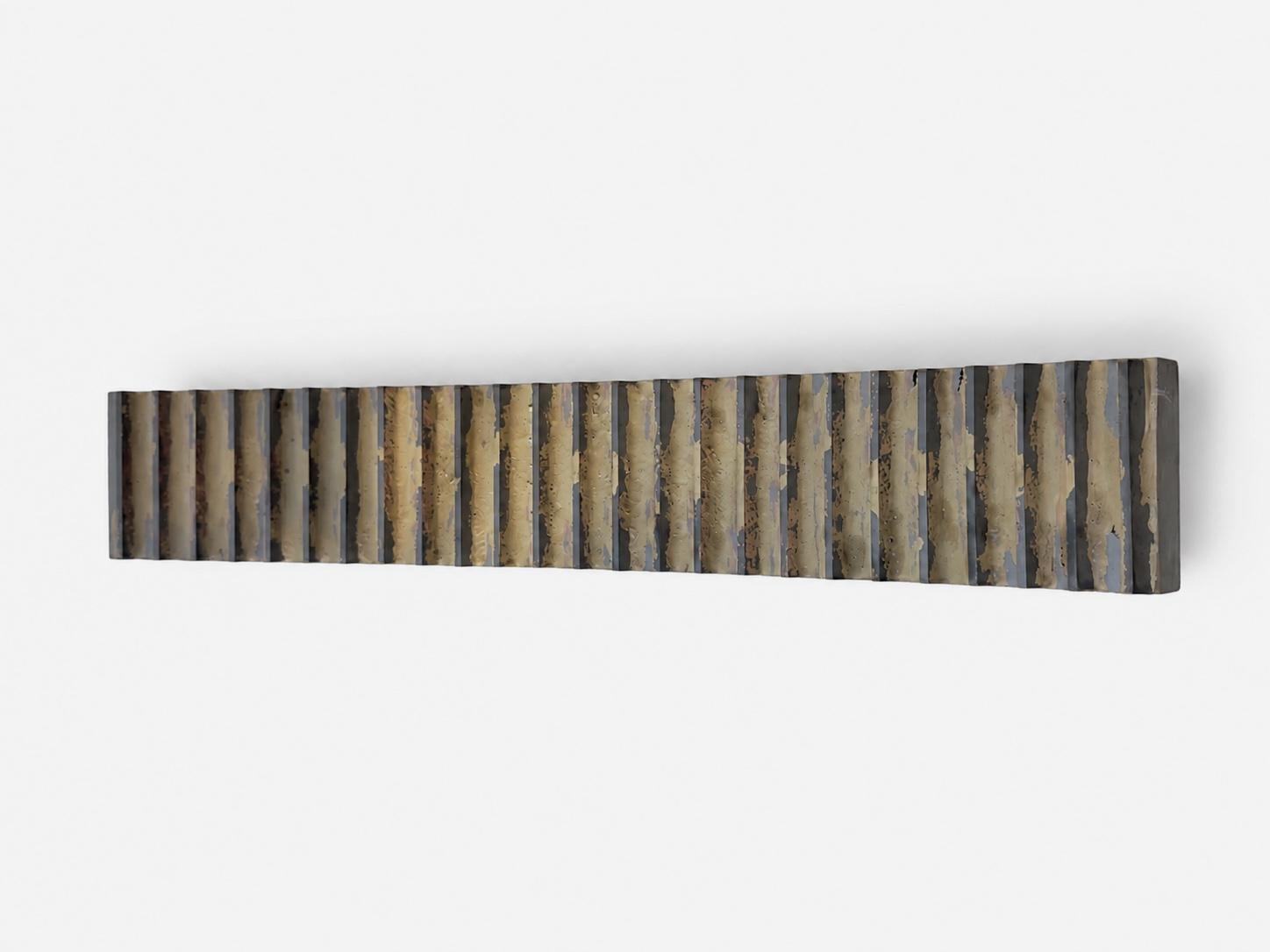
The ring body carries the load; the teeth take the wear. Hardfacing puts a tungsten carbide alloy layer on the tooth faces, so the surface being abraded is not the same material that has to hold the ring in shape.
The alloy is deposited tooth by tooth, then the surplus is ground back so the profile stays true. Coverage, layer thickness and the angle of the deposit are set for the tooth form and the duty — not applied as one recipe across every ring.
Hardfacing does not make a ring gear last indefinitely, and no honest figure can be quoted without the feed, the target fineness and the running hours. What it does is put the wear where it can be controlled, and keep the structural body out of the wear path.

The questions that matter are whether the teeth are covered where they work, whether the ring still measures true, and whether the joint or the seating face will load evenly.
On a worn ring, a single deep groove is a machine symptom rather than a reason to order a harder ring. Check load distribution, alignment and the hammer set first.
On a new ring, ask for the inspection record against the agreed drawing. The quality control page explains what is measured and how it is recorded.
A ring gear for pulverizer service is made to the machine, not chosen from a catalogue, so the first step is agreeing what the machine actually needs.
Where the worn ring can no longer be measured, the drawing and the machine data are used together, and anything still unresolved is raised before production rather than after.
This route is the same one described on our customization page; the grinding machine ring gear page covers the part on the machine side.

Q: How do I choose the right ring gear?
A: Start from the pulverizer model and the seating face, then the tooth form and the worn ring. Those three usually settle the specification.
Q: Are the teeth hardfaced as standard?
A: The working teeth are the part that wears, so hardfacing is normally applied there. The coverage is agreed per ring rather than assumed.
Q: Can you match a ring gear from a sample?
A: Yes. The sample is measured, and where a dimension is too worn to read, the drawing or the machine data is used instead.
Q: Can a split ring replace an integral one?
A: Sometimes, but it depends on the housing and on how the mill is serviced. Send the machine details and we will say which way it can go.
Q: What causes uneven tooth wear?
A: Most often alignment, feed entry or a hammer set that is no longer matched. A harder ring will not correct any of those.
Q: How long does a ring gear take to produce?
A: It is confirmed with the quotation, because it depends on the construction and the hardfacing route rather than on a fixed lead time for the whole range.
Send the pulverizer model, a drawing or photo of the worn ring, the feed being ground and the fineness you need through the inquiry form, and we will reply with a confirmed ring gear for pulverizer specification, price and delivery date.
If the ring is worn past the point where it can be measured, say so and send the machine details instead — that is enough to start, and it is more useful than a guess.